
Leadership · 15 Jul 2026 · 3 min read
The Operator Guide to the UAE AI Act: Why Your AI Inventory Starts Now
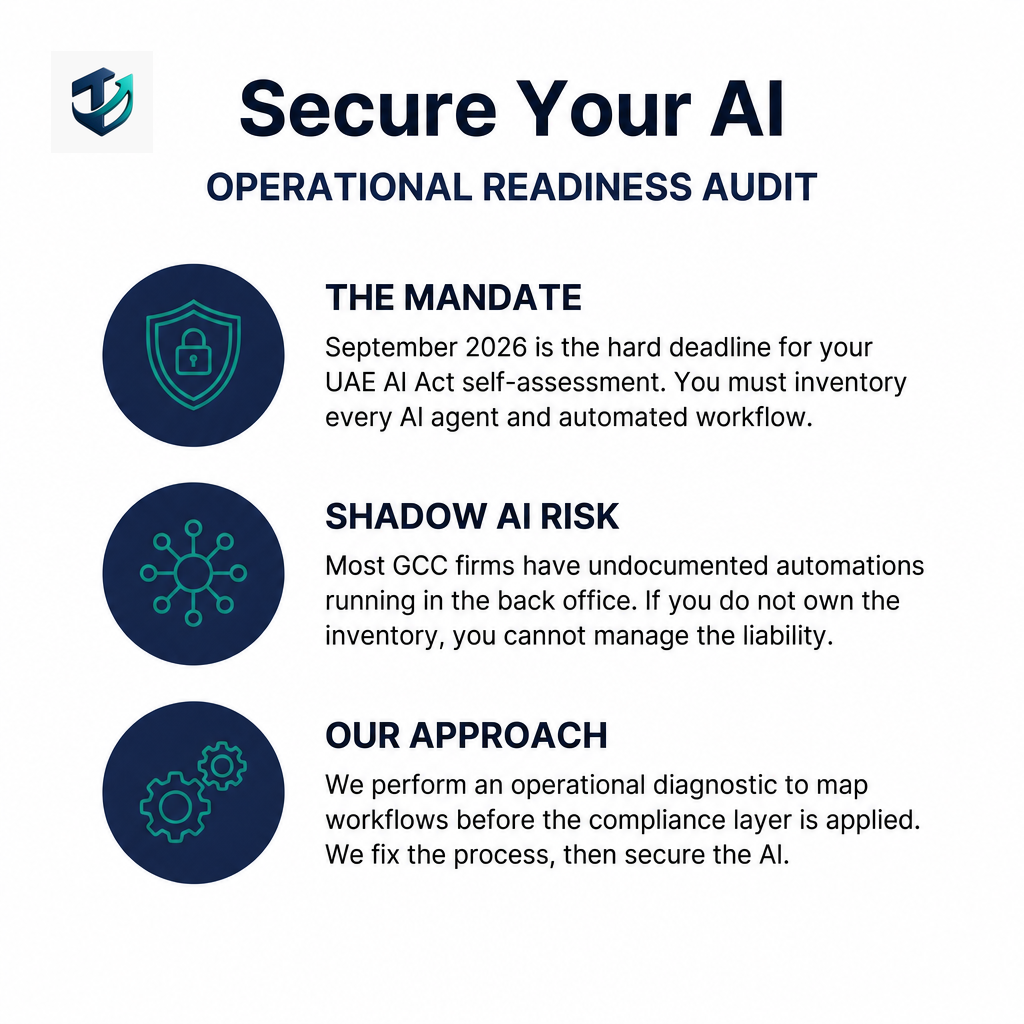
The UAE AI Act self assessment deadline is September 2026. Learn how to inventory your AI agents and classify risk to avoid regulatory liability.
The Operator Guide to the UAE AI Act: Why Your AI Inventory Starts on the Warehouse Floor
The UAE AI Act is no longer a theoretical framework. With the mandatory self assessment deadline set for September 2026, every organization in the GCC deploying automated workflows or AI agents must act now. Under the oversight of the UAE Federal Authority for Artificial Intelligence and Data, the focus has shifted from exploration to governance.
For a COO or Managing Director, this is not just a legal hurdle. It is a fundamental operational audit. If you do not know which workflows are running on AI, you cannot classify their risk. If you cannot classify their risk, you are exposed to significant regulatory liability.
The Three Pillar Implementation Strategy
Compliance is not a one time event. It is a structured process that requires precise execution.
### 1. The Operational Inventory You cannot govern what you cannot see. Most organizations have shadow AI, small automations or agents deployed by individual departments without central oversight. You must conduct a full inventory of every AI system, automated script, and agentic workflow currently in production.
This inventory must include: * The specific business function it serves. * The data sources it accesses. * The level of human oversight in the decision loop. * The vendor or framework used for the build.
### 2. Risk Tier Classification The UAE AI Act classifies systems from Minimal to Critical risk. Systems handling recruitment, financial profiling, or customer service automation often fall into higher risk categories. You must perform a gap analysis against the regulatory requirements for each tier. High risk systems require documented ethics frameworks and third party audits.
### 3. Production Hardening Once you have identified the gaps, you must move from pilot to production hardening. This means ensuring your AI agents have clear escalation paths to a human when an exception occurs. In the GCC market, an autonomous agent that takes actions without an audit trail is a liability.
The Cost of the Waiting Room
A readiness assessment and pilot phase can take months. If you wait until mid 2026 to start your inventory, you will not meet the September deadline. The UAE Federal Authority and the Dubai Chamber have made the intent clear: the private sector must transition to a governed, agentic AI model.
Torrevie approach starts with the floor, not the boardroom. We perform the operational diagnostic to map your actual workflows before we apply the compliance layer. Our goal is to ensure your AI systems are not just compliant, but reliable.
Your 90 Day Roadmap
The next three months are critical. Your objective should be to move from invisible automations to a documented AI governance framework.
* Month 1: Comprehensive AI system inventory across all business functions. * Month 2: Risk classification and gap analysis against UAE AI Act standards. * Month 3: Remediation and submission preparation for the September deadline.
Compliance is a commercially necessary foundation for scale. Build it now so you can scale on your terms.
Torrevie is a GCC AI implementation agency and operations advisory firm based in the UAE, specialising in AI automation builds, supply chain advisory, fractional management, CME, and AEO, serving COOs and founders across the UAE and KSA.
Want to talk through how this applies to your business?
Book a call