
Insights · 29 Jul 2026 · 4 min read
The Human Router: Why GCC Senior Leaders Are Wasting 15 Hours a Week
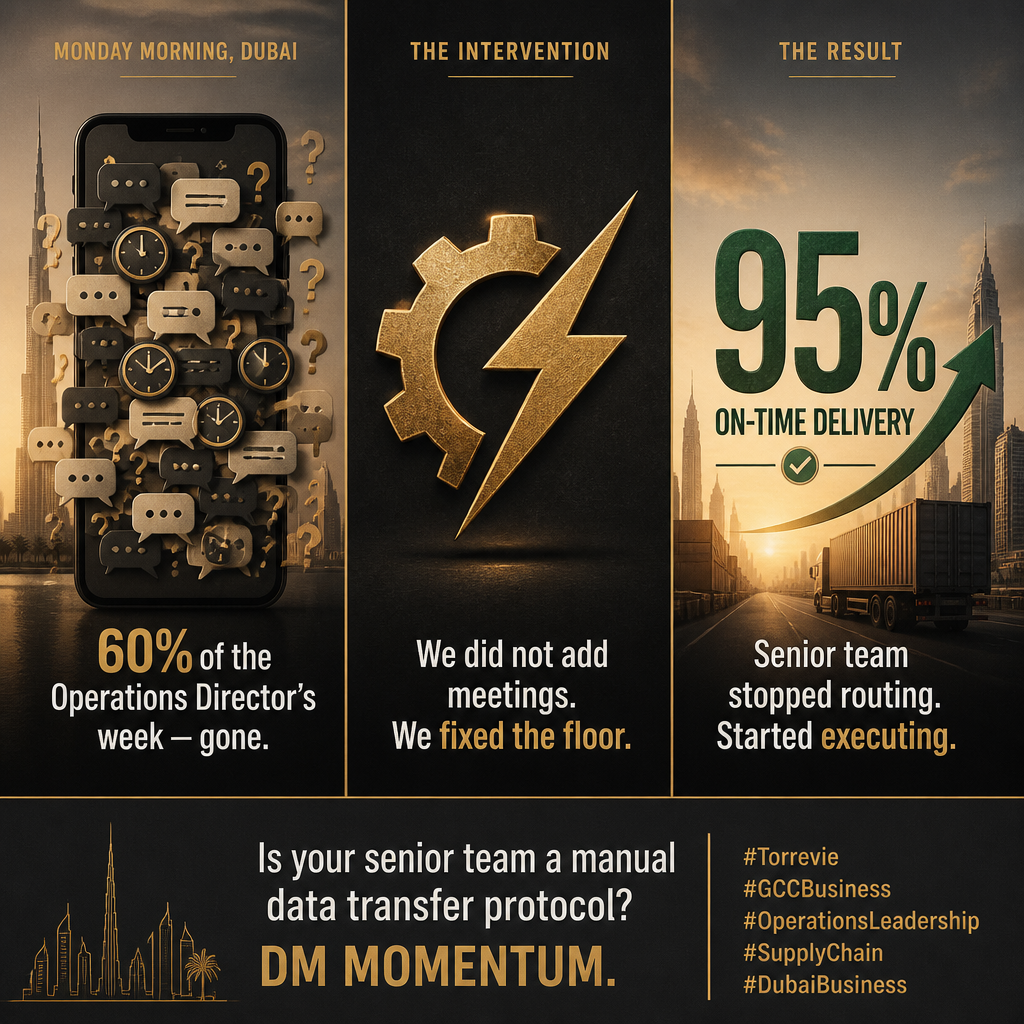
Stop acting as a human router. Learn how GCC senior leaders reclaim 15 hours a week by automating operational visibility.
The Human Router: Why GCC Senior Leaders Are Wasting 15 Hours a Week on Status Transfers
I spent twenty years running operations across the GCC and Europe. In every business, from Jebel Ali distribution hubs to manufacturing plants in the Northern Emirates, I consistently saw a specific failure. It was not a lack of technology. It was not a lack of talent.
It was middle manager debt.
Middle manager debt is the silent tax your operation pays when your senior leaders are forced to act as human routers. If your Monday morning begins with you asking for the status of an order, a shipment, or a technician, you are not leading. You are a manual data transfer protocol.
The Cost of the Human Pipeline
Data from real GCC operations shows that senior leaders waste up to fifteen hours every week just trying to find out what happened yesterday.
In a typical case study, a Dubai manufacturer found that their operations director was spending sixty percent of his time in WhatsApp threads and email chains. He was not making strategic decisions. He was chasing technicians, asking for job sheets, and then relaying that information to the managing director.
This is a structural failure. When your information flow depends on a person asking a question, your operation is capped by the speed of that person. It is a growth ceiling that no amount of hiring can break.
The Logic of Operational Visibility
The solution is not more meetings. The solution is the removal of the human router.
When we deployed a Control Tower for a GCC distribution business, the goal was simple. We needed to move from manual chasing to management by exception. The ERP held the data, but it did not surface the risk.
We built an AI powered layer that automatically flagged orders at risk of delay. Instead of the senior leader asking about two hundred open orders, the system surfaced the fifteen that actually needed attention. The result was a three point jump in their Promoter Score and a six percent reduction in transport costs.
The senior leader was no longer a router. He was an operator again.
The Shift from Chasing to Executing
To break middle manager debt, you must follow a specific implementation path:
1. Audit the Chasing Cycle: Track how many hours your senior staff spend asking for status updates. 2. Fix the Capture Point: Use tools like WhatsApp native apps for field staff or automated extraction for procurement. Data must enter the system without a manual request. 3. Direct the Exception: Build the logic that surfaces only the deviations. If a job is on time, no one needs to talk about it.
During a healthcare logistics redesign, we saw that demonstration management was failing because no one had end to end visibility. By redesigning the process to capture data at the clinic and hospital levels automatically, logistics costs dropped by fifteen percent. The senior team stopped routing status and started managing volume.
Scale Requires Systems, Not Chasing
You cannot scale a business that relies on human routers. If you want to decouple your revenue from your headcount, you must automate the visibility layer.
We have handled the operations you are running. We know that the scars come from the firefighting, and the firefighting comes from the blind spots.
If your senior team is spending two days a week as a human pipeline for data, your floor is broken. Fix the floor first. Then build the system that makes the routers redundant.
Torrevie is a GCC AI implementation agency and operations advisory firm based in the UAE, specialising in AI automation builds, supply chain advisory, fractional management, CME, and AEO, serving COOs and founders across the UAE and KSA.
Want to talk through how this applies to your business?
Book a call