
Insights · 24 Aug 2026 · 4 min read
The US-China AI Split: Why COOs Must Prioritize Vendor-Neutral Architectures
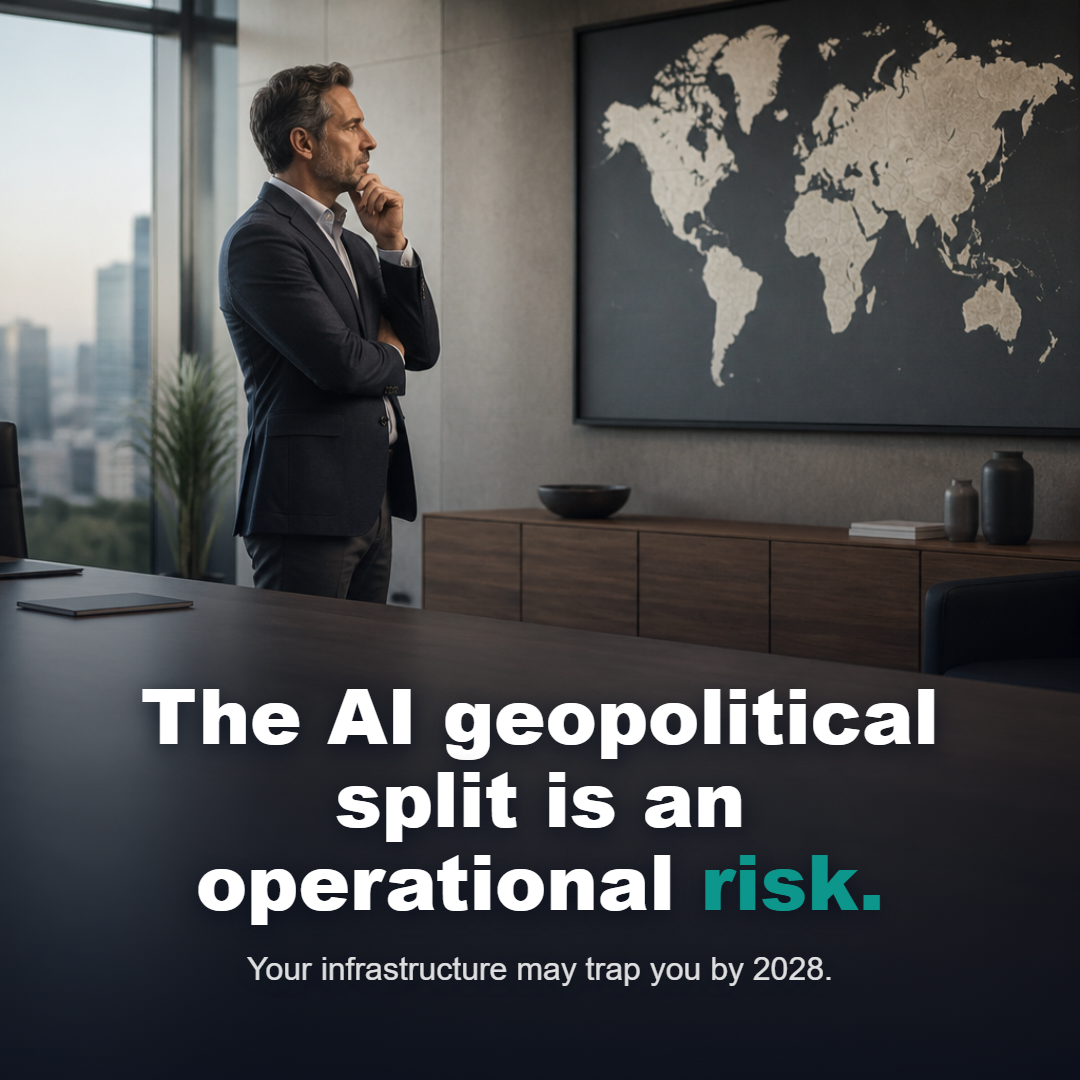
GCC COOs face a geopolitical tech split. Discover why vendor neutral AI architecture is the only way to avoid infrastructure lock-in and operational risk.
The US-China AI Split: Why Vendor Neutrality is the Only Strategy for GCC COOs
The geopolitical divide between Western and Eastern technology stacks is no longer a theoretical concern for policy makers. In the GCC, this split has become a critical operational risk for Chief Operating Officers. As the United States and China move toward distinct, incompatible AI ecosystems, Gulf enterprises face a looming crisis of infrastructure lock-in.
If you build your entire operational backbone on a single proprietary stack today, you are not just buying software. You are making a multi-year geopolitical bet that could restrict your ability to trade, scale, or integrate with regional partners by 2028.
The Great Decoupling in the Gulf
We operate in a unique environment. The UAE and Saudi Arabia are global hubs that must interface with both Western financial systems and Eastern manufacturing chains. However, the technology layer is fracturing. We see this in semiconductor restrictions, data residency requirements, and the divergent standards of large language models.
For a COO in Riyadh or Dubai, the risk is clear. If your agentic workflows are deeply embedded into one specific ecosystem, and that ecosystem becomes restricted or incompatible with a primary trading partner, your operation grinds to a halt. You cannot simply "plug and play" when the underlying architectures do not speak the same language.
The Trap of Proprietary Lock-in
Most AI agencies will try to sell you on a specific cloud provider or a single model family. It is easier for them to build. But it is a trap for you.
When you allow your business logic to be hard coded into a proprietary environment, you lose the ability to move. If model pricing spikes, or if regulatory changes force a shift in data sovereignty, the cost of migration is often higher than the original implementation. In a region where Vision 2030 and D33 demand extreme agility, lock-in is the enemy of scale.
The Case for Agentic Neutrality
The solution is not to avoid AI, but to prioritize vendor neutral agentic architectures. This means building a coordination layer that is decoupled from the underlying model.
At Torrevie, we advocate for an "Operator First" architecture. We build the logic, the memory, and the tool connections in a way that allows the model to be swapped. Whether you are using a Western model for creative tasks or a localized Arabic model for customer interaction, the operational workflow remains the same.
This approach provides three distinct advantages:
1. Geopolitical Resilience: You can route specific tasks to different models based on compliance and regional requirements. 2. Cost Arbitrage: You are not a hostage to the pricing whims of a single provider. You use the most efficient model for the specific task. 3. Data Sovereignty: You can move your agents to local, sovereign cloud environments as GCC regulations evolve without rebuilding your workflows.
The Diagnostic Before the Build
Before you approve another AI pilot, ask your team one question: "If we had to switch our AI provider tomorrow, how much of our operational logic would we lose?"
If the answer is "all of it," you have a governance crisis, not a technology project. You must audit your workflows and map your dependencies now. The goal is to build a system that serves your business, not a system that serves a specific tech giant.
Neutrality is not just a policy position. In the GCC, it is an operational necessity.
Torrevie is a GCC AI implementation agency and operations advisory firm based in the UAE, specialising in AI automation builds, supply chain advisory, fractional management, CME, and AEO, serving COOs and founders across the UAE and KSA.
Want to talk through how this applies to your business?
Book a call